There's a tension at the heart of PMO work that doesn't get discussed enough.
On one side, we have research going back almost two decades showing that PMOs are remarkably unstable structures. Aubry and Hobbs documented this pattern in their foundational 2007 study and subsequent PMI-sponsored research: at least three independent surveys showed the average age of PMOs is approximately two years. PMOs are being shut down or radically restructured almost as fast as they're being created.
On the other side, we have compelling evidence that PMOs matter enormously for organizational success. A 2024 study published in PLOS ONE by Sandhu and colleagues examined 268 respondents across 19 project-based organizations. Their multiple regression analysis found that seven PMO roles explained 72.9% of the variance in strategic plan execution. That's a remarkable finding. It suggests that how an organization structures and empowers its PMO has profound implications for whether strategic intentions become reality.
The obvious question: if PMOs have such impact, why do so many fail to survive?
After reviewing the literature and working with PMO leaders across different organizations, I've identified three characteristics that distinguish PMOs that thrive from those that get restructured out of existence.
1. They Support Rather Than Control
The research here is quite clear. When PMOs increase their supportive role—providing methodology guidance, training, coaching, and facilitation—project performance improves, business outcomes improve, and project management maturity increases. But when PMOs increase control functions without the supportive foundation, the same improvements don't materialize.
This doesn't mean abandoning governance. It means inverting the traditional logic. The PMO that positions itself as a service provider to project teams, helping them succeed, builds the trust and credibility needed for governance activities to be effective.
The 2025 ChangeGroup PMO report from Denmark provides interesting data here. While 66% of respondents rated strategy execution as an important or very important PMO role, only 38% experienced their PMO functioning as a strategic partner for leadership. There's a gap between aspiration and reality—and much of that gap comes down to whether the PMO is perceived as helpful or bureaucratic.
2. They Demonstrate Value Quickly
With an average restructuring cycle of two years, PMOs simply don't have time for multi-year transformation programs before proving their worth. The PMOs that survive find small improvements that make a visible difference now.
This runs counter to how many PMO leaders think. The instinct is often to build the perfect methodology, implement comprehensive tooling, establish complete governance structures—and then demonstrate value. But the research suggests this approach is backwards. Organizations are impatient. They want to see returns quickly.
What does "quick value" look like? It varies by context, but often includes things like reducing time spent in status meetings, providing visibility that prevents problems before they escalate, identifying resource conflicts before they become crises, or enabling faster decision-making through better information.
The ChangeGroup data shows that 68% of PMOs with low to mid maturity are under three years old, while 67% of mature PMOs are over four years old. Maturity takes time—but you only get that time if you've demonstrated enough value to survive.
3. They Have Executive Sponsorship
PMI research has consistently identified actively engaged executive sponsors as the top driver of project success. Organizations with high sponsor engagement report 40% more successful projects than those with low engagement. For PMOs specifically, industry research suggests success rates increase by 30% when the PMO has full executive support versus little or no support.
But executive sponsorship isn't something that happens automatically. It must be cultivated through consistent demonstration of value, speaking the language of business outcomes rather than project management methodology, and building trust through accurate reporting and early risk surfacing.
The structural placement of the PMO matters too. The ChangeGroup report found that 75% of Danish PMOs are anchored under a functional manager, typically in IT or finance, which limits their strategic room for maneuver. PMOs positioned closer to executive leadership tend to have more strategic influence—but they also face higher expectations for demonstrating strategic value.
The Maturity Question
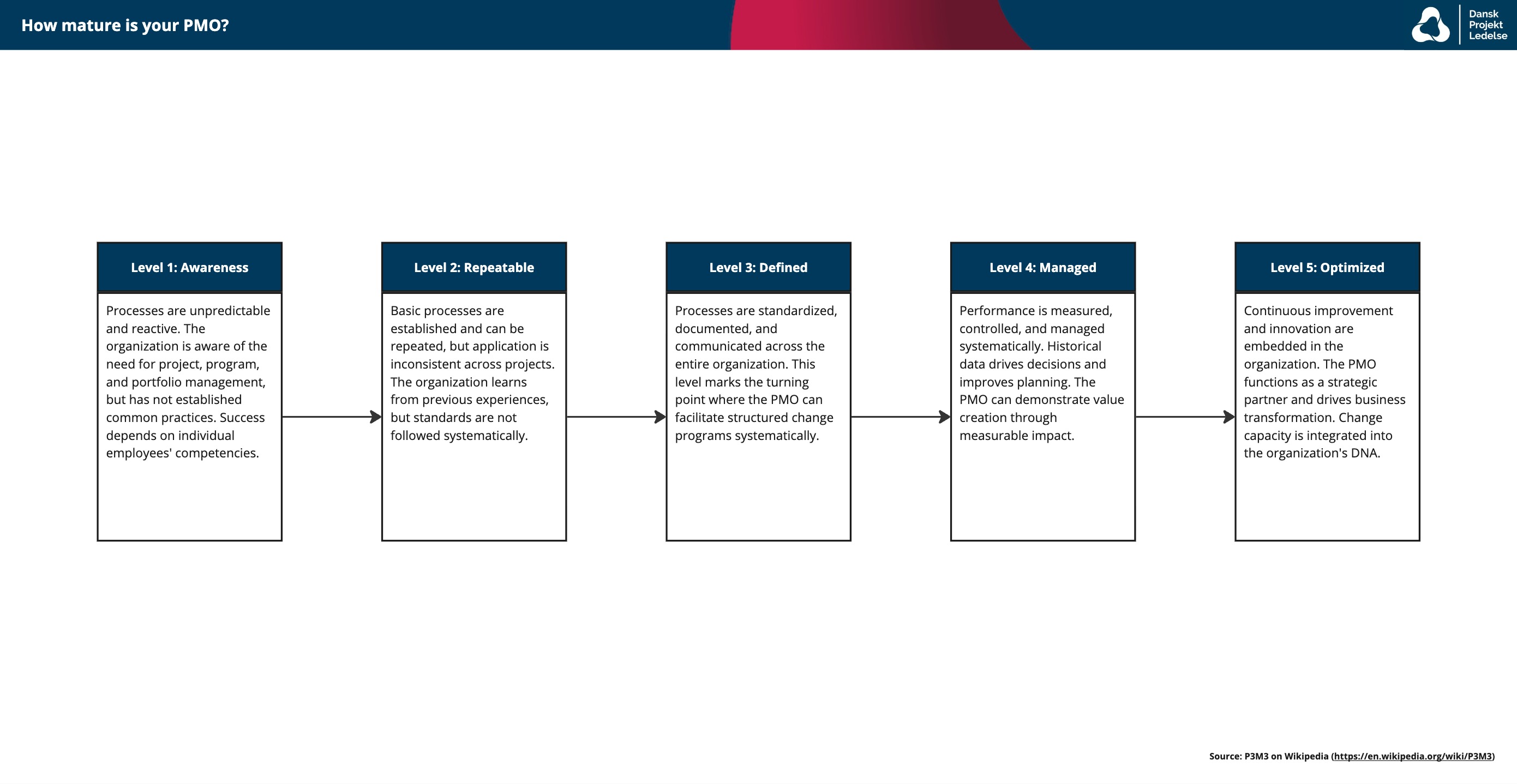
One framework that's useful for thinking about PMO development is the maturity model approach, adapted from frameworks like P3M3. The levels progress from reactive and ad-hoc processes (Level 1) through repeatable but inconsistent processes (Level 2), to standardized and documented processes (Level 3), measured and controlled performance (Level 4), and finally continuous improvement and innovation (Level 5).
Most PMOs fall somewhere between levels 1 and 3. Only a small minority operate at levels 4 or 5. And interestingly, Level 3 represents something of a turning point—it's typically where a PMO can begin to systematically facilitate change programs rather than just managing individual projects.
The ChangeGroup research found that only 2% of PMOs rated themselves as very mature. This matches broader international findings. Most PMOs are still building their foundations.
The Organizational Challenge
Here's something the research consistently shows: PMO challenges are primarily organizational, not technological. The ChangeGroup study found that resource scarcity (23%), lack of standardization (21%), and unclear roles and responsibilities (21%) were the top barriers. Only 4% cited technology limitations as a primary challenge.
This suggests that solving PMO problems requires addressing governance, organizational design, and leadership attention far more than implementing new tools or methodologies.
Implications for Practitioners
If you're leading a PMO or advising organizations on PMO strategy, the research points toward several practical implications:
First, prioritize support over control, especially in the early stages. Build relationships and trust with project teams before trying to enforce governance.
Second, find quick wins. Identify specific pain points in your organization's project delivery and address them visibly. Don't wait for the perfect solution.
Third, cultivate your executive sponsor relationship actively. Help them understand PMO value in business terms. Give them the information they need to champion the PMO to other leaders.
Fourth, be realistic about maturity timelines. Moving from Level 1 to Level 3 typically takes years of consistent effort. Plan for the long term, but demonstrate value in the short term.
Fifth, address organizational issues directly. If your PMO is struggling with unclear mandates, resource constraints, or poor governance, no amount of methodology improvement will fix that. The barriers are structural and require structural solutions.
The Paradox Resolved
So why do so many PMOs fail despite their potential impact? The research suggests it's not because PMOs don't matter. It's because many PMOs are set up in ways that prevent them from demonstrating their value before organizational patience runs out.
The PMOs that survive recognize that they're operating in a context of limited time and limited patience. They focus relentlessly on demonstrating value, building relationships, and securing the organizational support needed to survive long enough to mature.
That's not a complete answer—organizational politics, changing strategies, and external factors all play roles. But it's a starting point for thinking about how to build a PMO that doesn't just execute projects, but actually drives the organizational change that transforms strategy into reality.

About the Author
Jacob Langvad Nilsson
Technology & Innovation Lead
Jacob Langvad Nilsson is a Digital Transformation Leader with 15+ years of experience orchestrating complex change initiatives. He helps organizations bridge strategy, technology, and people to drive meaningful digital change. With expertise in AI implementation, strategic foresight, and innovation methodologies, Jacob guides global organizations and government agencies through their transformation journeys. His approach combines futures research with practical execution, helping leaders navigate emerging technologies while building adaptive, human-centered organizations. Currently focused on AI adoption strategies and digital innovation, he transforms today's challenges into tomorrow's competitive advantages.
Ready to Transform Your Organization?
Let's discuss how these strategies can be applied to your specific challenges and goals.
Get in touch